
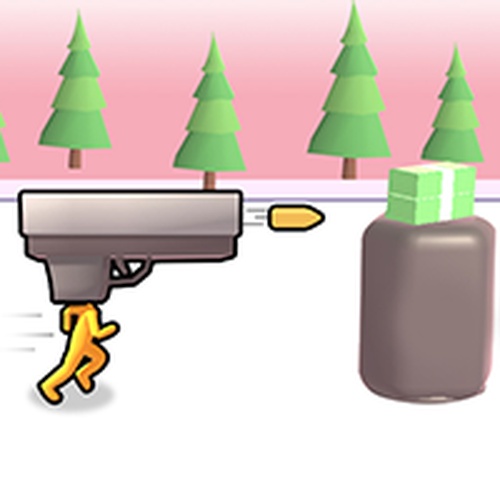
Core Gameplay Loop
In Speed Sprint, the primary objective is to travel as far as possible along a continuously generated path. The character moves forward automatically, and the player's only control is to tap or click. Each tap makes the character jump over a low barrier or, depending on the situation, shift to an adjacent lane to avoid an obstacle. The simplicity of this interaction allows players to focus entirely on timing and spatial awareness. As the run progresses, the game's speed gradually increases, requiring faster decision-making. The challenge lies in maintaining concentration over longer distances, as a single mistimed tap can end the run. This straightforward yet demanding loop creates a satisfying cycle of trying to beat one's own best distance.
Visual Design and Atmosphere
The game presents a bright, colorful world with a clean aesthetic that appeals to a broad audience. Backgrounds feature shifting landscapes, from grassy plains to rocky terrains, which change as the player advances. These visual updates provide a sense of progression without distracting from the core gameplay. Character and obstacle designs are simple but distinct, making it easy to identify threats at a glance. The overall art style is cheerful and non-threatening, ensuring the experience remains suitable for younger players. Smooth animations and a consistent frame rate contribute to a polished feel, even during fast-paced segments. The visual feedback for successful jumps or collisions is clear, helping players understand the consequences of their actions instantly.
Progression and Difficulty Curve
Speed Sprint employs a gradual difficulty curve that introduces new obstacle patterns as the player's distance increases. Early runs feature widely spaced barriers and generous reaction windows, allowing newcomers to learn the basic rhythm. After covering a certain distance, the game begins to present combinations of obstacles, such as a low barrier followed immediately by a gap that requires a precisely timed jump. The speed increase is not abrupt; it ramps up smoothly, giving players time to adjust. This design encourages repeated attempts, as each run feels slightly different due to the procedural generation of the course. There are no checkpoints or power-ups, so every run is a fresh test of the player's current skill level. The lack of external aids keeps the focus on personal improvement and reflex development.
Accessibility and Platform Support
One of the key strengths of Speed Sprint is its accessibility. The game runs entirely within a web browser, requiring no installation or account creation. It is optimized for both desktop computers and mobile devices, with touch controls working seamlessly alongside mouse clicks. The interface is minimal, with no intrusive menus or advertisements that could interrupt the flow. This makes it an ideal choice for quick gaming sessions during short breaks. The rules are intuitive enough that a player can understand them within seconds, yet the challenge remains engaging for extended play. Because the game does not save progress or require an internet connection beyond the initial load, it respects the player's time and privacy. This straightforward approach aligns with the expectations of casual gamers looking for immediate, hassle-free entertainment.
Competitive and Social Elements
While Speed Sprint is primarily a solo experience, it includes a leaderboard feature that records the best distances achieved by players. This adds a light competitive layer, encouraging players to improve their performance to climb the rankings. The leaderboard is anonymous and does not require personal information, maintaining a low barrier to participation. Players can also challenge themselves by setting personal distance goals, such as reaching a specific landmark or surpassing a previous record. There are no in-game purchases or advertisements that could skew the experience, so the competition remains fair and skill-based. The social aspect is minimal but effective, providing motivation without creating pressure. This balance makes the game suitable for both solitary play and friendly competition among family members.

Comments
0 comments